- Needs To Exist
- Posts
- The Secret Blueprint Behind the Person Who Decides What’s “In”
The Secret Blueprint Behind the Person Who Decides What’s “In”

Needs To Exist
November 22, 2025
To most people she’s the bob and the sunglasses.
The ice queen from The Devil Wears Prada.
The woman interns are told not to look in the eye.
The person who can turn a tiny label into a global brand with one phone call… or one raised eyebrow.
But the real story is weirder and way more useful:
16-year-old who dropped out of school and went straight to work.
Daughter of “Chilly Charlie,” a ruthless London newspaper editor who worshipped discipline and brevity.
Teenager who went to clubs not to party but to study, drinking Shirley Temples and treating the dance floor like market research.
Assistant who got fired for being “too European” (translation: wouldn’t take direction, wouldn’t defer, assumed she was in charge).
She didn’t just run Vogue.
She turned “editor-in-chief” into a sovereign state:
5 a.m. workouts.
Two-minute meetings.
Emails with no subject lines.
Every shoot, guest list, and dress routed through one operating system: Does this meet my standard?
She built a machine where a council, a gala, and a magazine all quietly route power, attention, and money through Anna at the center.
Today’s It Exists: Anna Wintour.
The iron editor who used taste, control, and relentless standards to become bigger than her own institution.

Lesson 1 – Over-Define the Pinnacle
She leaves school at 16. “I wasn’t very good at school,” she says. “I just wanted to get on with things.”
She works shop floors at Biba and Harrods.
She gets her first editorial job at Harper’s & Queen because her dad pulls a favor. And even there, as a junior, people can feel it:
She doesn’t dress like staff; she dresses like the main character.
She doesn’t treat loaned clothes casually; she sends them back perfectly folded, down to the tissue paper.
She doesn’t want to be the one freezing on location doing the shoot; she wants to be in the office making the decisions.
At every magazine she joins, people joke: “We all know she wants to run Vogue.”
They’re not wrong. It just takes her 20 years.
👉 Takeaway: Most people aim at a field. She aimed at a specific throne. One mountain simplifies a lifetime of decisions.

Lesson 2 – Make the Environment Match Your Ambition
London fashion is cute. London media is prestigious. But for what she wants? Too small.
From the outside, “British fashion editor” sounds like a dream job. From the inside, she can feel the ceiling.
New York, on the other hand, is chaos:
Bigger audiences.
More money.
Editors who treat closing an issue like landing a plane, not wrapping a school play.
So she moves.
She revels in New York’s anonymity: no one cares who her father is, no one cares where she went to school. They only care if the work lands.
Later, when Condé Nast exiles her back to London to run British Vogue, she treats it like a tour of duty, not a homecoming. Her husband and kids stay in New York. She commutes, pregnant, exhausted, and still plotting how to get back to the real battlefield.
👉 Takeaway: If your ambition feels “too much” for your city, team, or peer group, that’s a signal. Your environment either amplifies your goals or suffocates them.

Lesson 3 – Time as a Blade, Not a Blanket
Her daily rhythm is closer to an athlete’s than a writer’s:
Up at 5:00 a.m.
Exercise at 5:30.
Professional hair and makeup.
Car to the office.
Three assistants waiting, laptops open, blank documents ready.
She walks in and starts talking; they type. No “good mornings,” no easing in. Just a stream of instructions. The emails she fires off come at all hours and have no subject lines. Just: do this, fix that, move this.
Her meetings become legend: two minutes long.
First minute is guaranteed.
Second minute is a courtesy.
That’s it.
Her predecessor at Vogue would run clothing meetings that lasted 8–10 hours, analyzing each look to death, saying things like “This needs more,” and nobody knew what “more” meant.
Anna walks in, looks at the board, and goes:
“Yes. No. No. Yes. Goodbye.”
People call it ruthless; she calls it efficient.
👉 Takeaway: Time pressure is a feature, not a bug. Short windows force clarity. If you force everything through tiny time slots, only the sharpest ideas survive.

But what can you actually DO about the proclaimed ‘AI bubble’? Billionaires know an alternative…
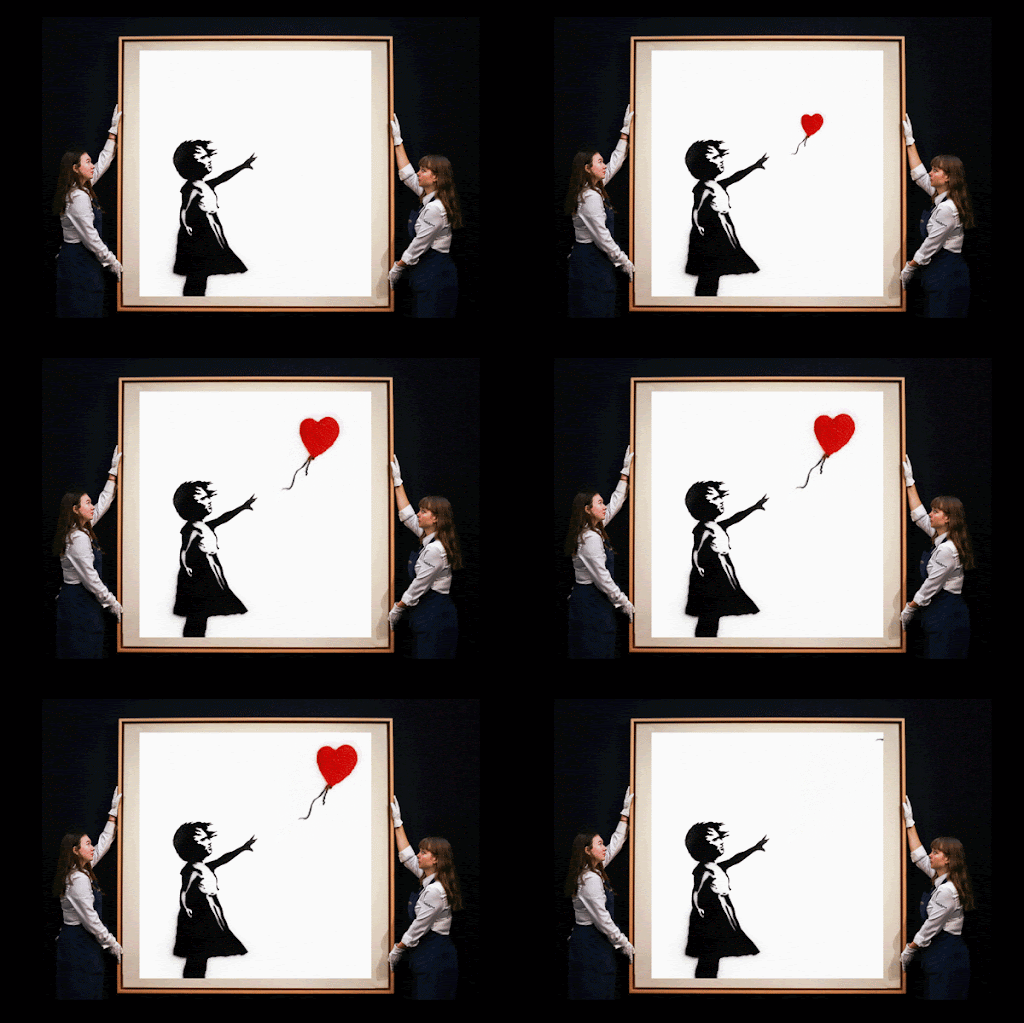
Sure, if you held your stocks since the dotcom bubble, you would’ve been up—eventually. But three years after the dot-com bust the S&P 500 was still far down from its peak. So, how else can you invest when almost every market is tied to stocks?
Lo and behold, billionaires have an alternative way to diversify: allocate to a physical asset class that outpaced the S&P by 15% from 1995 to 2025, with almost no correlation to equities. It’s part of a massive global market, long leveraged by the ultra-wealthy (Bezos, Gates, Rockefellers etc).
Contemporary and post-war art.
Masterworks lets you invest in multimillion-dollar artworks featuring legends like Banksy, Basquiat, and Picasso—without needing millions. Over 70,000 members have together invested more than $1.2 billion across over 500 artworks. So far, 23 sales have delivered net annualized returns like 17.6%, 17.8%, and 21.5%.*
Want access?
Investing involves risk. Past performance not indicative of future returns. Reg A disclosures at masterworks.com/cd
Lesson 4 – Guard the Work, Not the Vibes
Shoots for Vogue can cost six figures.
She kills them anyway.
Photographer brings in a portfolio? If she doesn’t like it, there’s no fake “I’ll think about it” to protect feelings. It’s a no.
A big-name photographer once delivers a spread. She shrinks the image down to something “the size of a postage stamp.” Staff protest: “You can’t do that, it’s Lord Snowden!” She does it anyway.
She tells young designers to ignore short-term cash grabs that will cheapen their brand. Some listen and survive. Others chase the money and die.
When the entire industry is built on being nice, flattering, and performatively soft, she’s the opposite:
Decisive. Blunt. Protective of the magazine like it’s her kid.
👉 Takeaway: If everyone else is optimizing for “polite,” there’s a huge edge in optimizing for “true.” Someone has to choose the work over people’s feelings.

Lesson 5 – Turn a Job into an Ecosystem
On paper, she gets the job her dad told her to write down: editor-in-chief of Vogue in 1988.
Most people would stop there. She doesn’t.
She starts acting less like “editor of a magazine” and more like “central banker of the fashion world.”
She builds three big levers:
The magazine – being in Vogue can make a brand. Not just “nice for press” but “we can pay rent now.” That alone is power.
The Met Gala – she turns a museum fundraiser into a global status summit. She controls:
Who gets invited
Who sits next to whom
Which labels dress which celebrities
Brands buy tables, but even if you pay, she still approves your guest list. She uses the rooms to mix designers, investors, celebrities, and CEOs so deals happen. It’s a business conference in couture drag.
The CFDA/Vogue Fashion Fund – she helps set up a fund that hands young designers money and mentorship. Winning can literally be the difference between bankruptcy and superstardom.
The result:
Designers owe her.
Investors call her to ask who to back.
Brands advertise not just for sales, but to stay in her good graces.
The editor’s chair becomes a power router.
👉 Takeaway: A role is small. A platform is bigger. An ecosystem is when everyone’s incentives quietly run through you.

Lesson 6 – Details as a Religion
She insists she’s “not a creative person” - can’t draw, can’t sketch, can’t make clothes.
Then she turns around and controls everything else:
The tissue paper clothes come in.
The exact way racks are rolled into her office before a shoot.
The desk she works at (large, white, so she can see clothes clearly).
The ingredients in the food at the Met Gala.
The order of images in the issue.
The final “AWOK” initials that decide whether something gets in or not.
She learned it watching her father:
Clean desk, rapid decisions, one-word comments.
No clutter, no dithering, no ambiguity.
Her own version is just more intense and covered in Chanel.
👉 Takeaway: “Vision” is mostly manifested in tiny, boring specifics. If you don’t care about those, your vision leaks.

For most people in fashion, parties are perks.
For Anna, they’re infrastructure.
She treats every dinner, show, and gala like a routing table:
Who needs to meet whom
Which young designer should sit next to which CEO
Which sponsor needs to feel like they’re in the inner circle
The Met Gala is the apex of this: you can’t buy your way in. You can buy a table, but you still need her approval to fill it. And she uses that leverage to keep everyone orbiting her.
Designers get introduced to backers.
Executives get soft pressure to support certain labels.
Celebrities get knitted into fashion narratives that sell clothes for years.
She’s not just mingling; she’s doing portfolio construction in evening wear.
👉 Takeaway: If you’re already going to be in the room, you might as well own the map. Curating who talks to whom is its own power.

Lesson 8 – Make Other People’s Careers, Then Call in the Favor
The CFDA/Vogue Fashion Fund is the cleanest example.
A young label gets:
A check
Access to Vogue
Access to Anna
Introductions to top executives
One winner says the money came and went, but the mentorship and relationships lasted years. Another admits that ignoring her operational advice became “one of the death nails” of his brand.
She doesn’t ask for equity; she asks for excellence and loyalty.
Over a decade, you get dozens of designers who literally feel like they owe their careers to her. At the same time, investors and corporate buyers start calling her:
“Who should we look at?”
“Who’s actually good?”
“Who’s the next one?”
She does so much for so many that when she needs a favor like a board seat, a campaign, a donation, a partnership the yes is already pre-paid.
👉 Takeaway: Power compounds fastest when you’re in the business of minting other people’s success.

Lesson 9 – Persona Is a Tool, Not the Product
Then The Devil Wears Prada comes out.
Meryl Streep plays a terrifying, hyper-competent editor everyone understands is based on Anna. Her daughter watches the trailer and says, “Mom, they really got you.”
Suddenly she’s not just fashion-famous. She’s culture-famous:
TV specials
Late-night jokes
“Most Fascinating People” lists
The bob and sunglasses become a logo.
It would be easy to believe the myth at that point. To think the persona is the main thing.
She doesn’t.
She tells people, basically: this is all contingent. The aura exists because she sits in that chair. If she ever loses the job, the glow dims.
The public character is just a costume. Useful. Profitable. But secondary.
The primary thing is the machine:
The calendar, the standards, the network, the ecosystem.
👉 Takeaway: Brand is leverage. But if you mistake the cartoon of you for the operator inside, you’ll spend all your time polishing mirrors instead of building engines.
If Anna Wintour were starting today, she wouldn’t be pitching glossy print layouts.
She’d probably be building the OS for taste on the internet:
A fund + platform that spots breakout brands, gives them money, plugs them into distribution across TikTok, Instagram, newsletters, and pop-ups, and hosts a “Met Gala for creators” where everyone collides.
Same core game:
One clear pinnacle.
One city that matches her ambition.
Time as a knife.
Work over feelings.
An ecosystem where everyone wins more by keeping her at the center.
That’s the kind of thing we tag and store inside NTE Pro: not just “Anna Wintour is intense”, but how she turned a job into an empire, so you can steal the structure even if your “Vogue” is a SaaS, a newsletter, or an AI product.
If you want to go deeper on how this machine was actually built, listen to the Founders Podcast episode on Anna Wintour and then read Anna: The Biography by Amy Odell. It’s the closest thing to an operator’s manual for how someone turns taste into power, a job into an ecosystem, and a persona into pure leverage.