- Needs To Exist
- Posts
- Stop being your own worst-paid employee
Stop being your own worst-paid employee

Needs To Exist
May 31, 2026
In partnership with

It's Sunday. Somewhere on this list is a person who recently did the thing. Left the long job. Registered the company. Put "Founder" in the headline next to a knot in the stomach.
This one's for you. And for the bigger group standing at the edge of the same jump.
We talked about why the timing is good. Today is the part that matters more: what to actually do about it this week. Not a vibe. A playbook. With tools and prices.

The one fact worth keeping.
The huge AI headline this week was Anthropic raising $65 billion. Ignore the number. Here's the part that's about your life.
That whole industry exists because companies will now pay real money for software that does the work instead of describing it. For a giant, that's a line item. For you, it's the first hire you can't afford, suddenly available for the price of a phone plan.
The thing that kills new solo businesses was never the craft. It's the admin around the craft. The phone you can't answer mid-job. The quote you write at 10pm. The invoice you forget to chase. The marketing you keep meaning to do. That's the work that eats the week, and it's the work that just got cheap.
So here's the Sunday plan. Four steps. You can start today.

Step 0: Do recon before you build anything.
The most expensive mistake is building into a void. Before you wire up a single tool, find out who's already doing what you do, and how.
This is the step we'll do with you. Reply to this email with your corner of the world. The trade you know cold, or the one you just jumped into. Your role, and the one question you'd most want a stranger to answer this week. A few sentences is plenty. A website or LinkedIn helps us move faster.
We'll take a batch and run a personalized WhoFiled report on what's actually moving in your space. Not headlines. The boring layer: who's quietly tooling up, what they charge, where the gap is. The receipts before they reach your industry's press cycle. None of the reports we've run so far were the reader's idea. Yours could be the next one we publish.
Then, while we dig, you run the next three steps yourself.

Step 1: Kill the task you dread first.
Pick the single thing you avoid until Sunday night. Just one. Then hand it off this week.
If it's the phone, an AI receptionist answers every call, books the job, and texts you the details. Rosie starts at $49 a month. A human receptionist runs $45,000 to $53,000 a year. You are not choosing between those two. You're choosing between $49 and the calls you're currently sending to voicemail while you're under a sink.
If it's quoting and invoicing, Jobber ($29/mo) or Housecall Pro ($49/mo) turn a quote, a schedule, an invoice, and a payment reminder into about four taps.
If it's the writing, ChatGPT or Claude, both $20 a month, will draft the proposal, the follow-up email, and the website copy you've been putting off since you started.

Step 2: Stack, don't hire.
Here's the part nobody told the people who came before you. A full solo operation, the receptionist, the scheduling, the AI assistant, the automation glue, runs three to twelve thousand dollars a year. That's the all-in cost of the team you used to need ten people and a payroll to build.
So the rule for the first year is simple. Don't hire a person for anything a tool does at 80%. Hire a person only for the 20% that genuinely needs human judgment, and only once the revenue is real. Most functions never need a full-time body. A few do. The trick is knowing which, and not flipping that order.

Step 3: If you don't know what to build yet, fix that before anything else.
All of the above assumes you know what your thing is. A lot of you don't yet. You've got the nerve and not the target, and the blank page is winning.
That's the gap NTE Pro is built for. 7,000+ business ideas, the small and practical next to the wild and massive, sorted so you can find the one that fits the skills you spent twenty years building. It's not a course and it's not homework. It's what you open when the calendar is finally yours and the question sharpens to a point: do what, exactly. Some of these are a weekend. Some are the next decade. A few are one tweak from being the thing you actually do.

The honest part.
One in three new businesses now starts with a single person. More than half of today's solo owners started in the last five years. The leverage is real.
So is the other half nobody prints: solo operators report more stress and more burnout than owners with a team, and nearly half say they have no one to talk through the hard calls with. That's not a reason to stay at the job. It's the job description. The tools take the admin off your plate. They don't take the weight off your shoulders. The people who make it tend to be the ones who saw both coming.
The headline this week said a company got nearly as big as any company has ever been.
The part for you said the smallest possible business has never had this much room to work.
So pick the one task. Hit reply with your corner. Start today.
Stop babysitting dashboards. Ship from Slack. Touch grass.
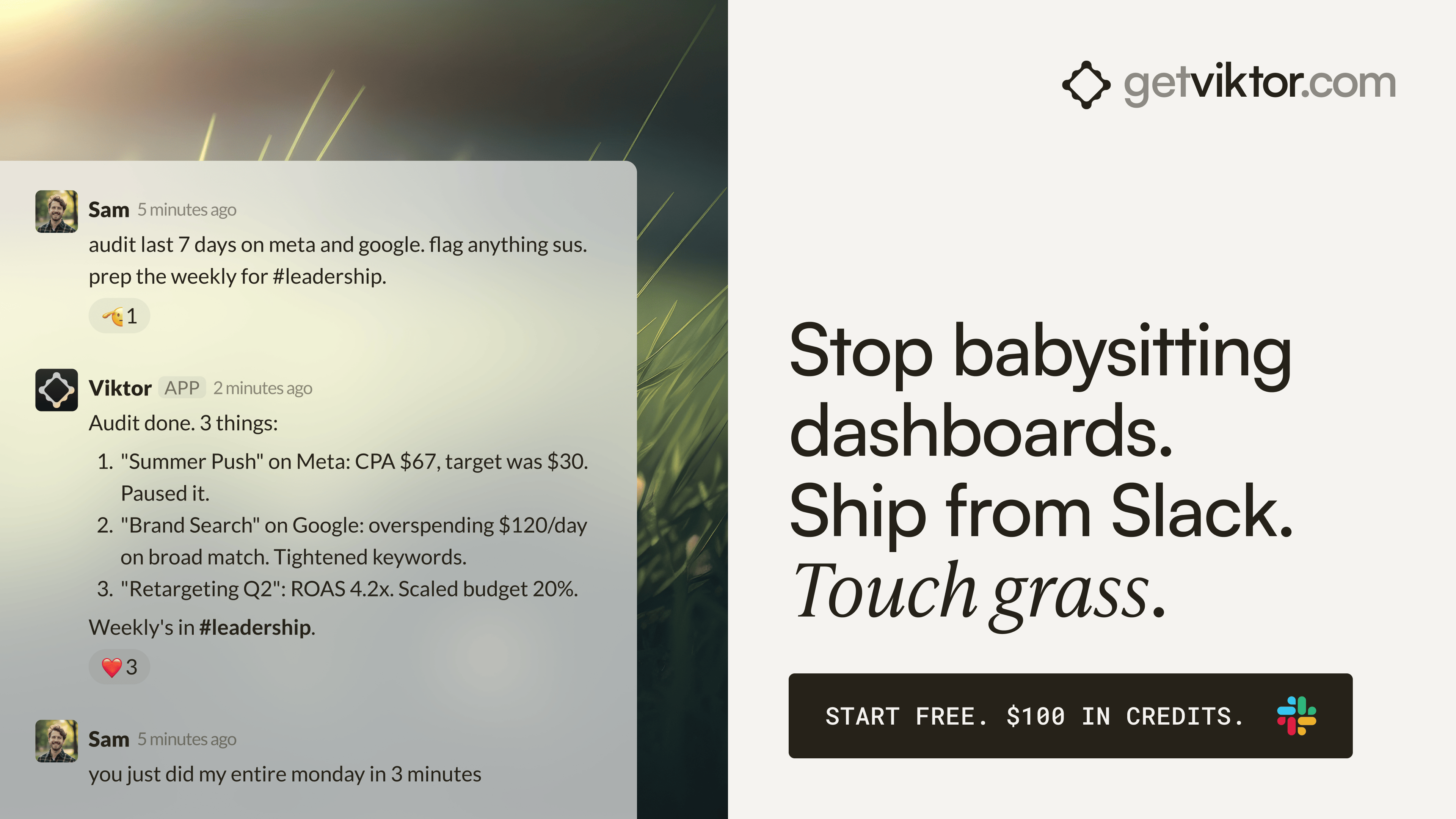
700+ teams have Viktor reading their Google Ads every morning.
Your media team opens Slack at 8am. There's a cross-platform brief in #growth: Google Ads spend vs. ROAS, Meta CPA by campaign, Stripe revenue by channel. Viktor posted it at 6am. Nobody asked for it.
Last week, one team's Viktor caught a spend spike at 2am on a broad match campaign and flagged it in Slack: "CPA up 340%. Recommend pausing and shifting budget to the top two performers." That would have burned $3K by morning. The media buyer woke up to a problem already handled.
Your strategist reviews spend trends. Your account manager checks revenue attribution. Same Slack channel, same colleague, before anyone's first coffee.
Google Ads, Meta, Stripe. One message. No Looker, no Data Studio. Anomaly detection runs around the clock. Cross-platform reporting runs on autopilot.
5,700+ teams. SOC 2 certified. Your data never trains models.
"Viktor is now an integral team member, and after weeks of use we still feel we haven't uncovered the full potential." — Patrick O'Doherty, Director, Yarra Web